Wednesday, November 10, 2010

The Big Top Goes Green


Concurrent with the 2010 Twain Centennial Celebration, The Mark Twain House & Museum has been helping to celebrate the bicentennial of another Connecticut icon this year – P.T. Barnum. The circus impresario and entrepreneurial legend was born in 1810 in Bethel, CT and we have been helping Bridgeport’s Barnum Museum with their year-long party by offering circus-inspired events in Hartford. This Saturday, November 13th at 11 a.m., we welcome ARTFARM, a Middletown, Connecticut based troupe that creates high quality theater with a commitment to environmental sustainability and social justice, and their high-flying Circus for a Fragile Planet. This program is the final of our 2010 "Saturdays with Sam" Family Matinees, so fill your clown car with the kiddies for this unique show!

Imagine a circus in which actors juggle bottled water, polar bears dance on melting ice floes, the props and set are recycled, and the core of clowns are called the Fossil Fools. That’s part of what you get in ARTFARM’s Circus for a Fragile Planet, a brand new educational circus performance featuring juggling, clowning, physical comedy, acrobatics, unicycling, stilt dancing and other circus arts built around a strong environmental message.

The show is written, directed and features ARTFARM co-founder Dic Wheeler, who plays an offbeat Austrian scientist whose attempts at enlightening the audience about critical environmental issues are undermined by three fun loving clowns with an agenda of their own. Featuring a lively contemporary and classical musical score, Circus for a Fragile Planet is a side-splitting, mind-opening blend of circus and science.


The fast-paced, hour-long show has entertained and inspired audiences of all ages. The circus has performed with great success at universities, arts centers, festivals and nature centers. What every audience receives is a terrific small-scale circus which leaves them asking “what changes can I make in my lifestyle to become a more responsible world citizen?” The show addresses issues such as global warming, critical habitat, resource management, alternative energy sources, bottled water, recycling, species sustainability and individual responsibility in a way that is accessible and upbeat, accentuating the positive choices each individual or community can make to help build a better future for the planet. And the company shows up in a colorful bus powered by waste vegetable oil!


Check out ARTFARM in action here!


Tickets for Circus for a Fragile Planet are only $5 for children and $10 for adults. To reserve, call (860) 280-3130 or purchase tickets at the door. "Saturdays with Sam" is supported by Aetna, Hartford Steam Boiler and the Connecticut Commission on Culture and Tourism.

Wednesday, November 3, 2010

This just might be your last reminder. No. I mean it this time.

By Susan Campbell

I'm teaching a course in creative non-fiction at Mark Twain House & Museum from 5:30 to 7:30 p.m. on Wednesdays from Nov. 10 to Dec. 22.

We'll explore the likes of E.B. White (of course), Kay Redfield Jamison, Azar Nafisi, Mark Twain, himself (of course) and many others. Come read some fabulous writers, and work on your own fabulous writing, as well.

The cost is $500 for the six-week course (no class is scheduled for November 24). To register, call Steve Courtney at 860-247-0998, Ext. 243, or email steve.courtney@marktwainhouse.org.

And yes, I'm pretty sure this is the last reminder because time is running out. That is all. Thank you.

Susan Campbell's Dating Jesus won the Connecticut Book Award for Biography/Memoir this year. She is an award-winning columnist at the Hartford Courant, where her work has been recognized by the National Women's Political Caucus, New England Associated Press News Executives, the Society for Professional Journalists, the American Association of Sunday and Feature Editors, the National Society of Newspaper Columnists, and the Sunday Magazine Editors Association. Her column about the shootings at lottery headquarters in March 1998 was part of The Courant's Pulitzer Prize-winning coverage. The mother of two adult sons, she has a bachelor's degree from University of Maryland and a master's degree from Hartford Seminary. She lives in Connecticut with her husband.

Friday, October 29, 2010

So what is Steampunk?


This Saturday at 2:00 (that's TOMORROW!), The Mark Twain House & Museum is thrilled to announce the first of several Steampunk events here at the museum. Our museum center will be filled with gears, goggles, and everything in between. Our host will be Miss Kitty, an elegant local Steampunk expert.

So what is Steampunk, you ask?

Steampunk is a subculture based on the ideas of Victorian science fiction and alternative history. That's a really clunky way to express a beautiful thing, so I will pass the explanations to Miss Kitty herself:

And just what is "Steampunk"? Steampunk is the future as imagined through the eyes of the past. It is mechanical gears and boilers, dirtiness mixed with shininess of brass and copper with the deep red of cherrywood. It is a time for tea and gadgets, airships and ether. Steampunk is a trip to the moon through the barrel of a cannon. It is progeny of Jules Verne and H. G. Wells finding their voice in fiction, fashion and music. Steampunk is all of these things, none of them and more. Steampunk is "punk". One doesn't need to go to the store to buy Steampunk. The do-it-yourself mentality reigns freely. Steampunk is what you make it, but you might want to bring some brass goggles along for the ride.

The Event will include a Victorian style afternoon tea with tea sandwiches, petite pastries, fruit, scones, tarts and other delectables and music, . Attendees are encouraged to come in costume, but it is not required.


Point being: Steampunk is a heck of a lot of fun. Come by and check it out!

Saturday, October 30 · 2:00pm - 4:00pm
The Mark Twain Museum Center
351 Farmington Avenue
Hartford, CT

Tickets for the Steampunk Tea will be $10 ($5 for Twain House members), and tickets for the Zombie panel at 4:00 are $5 (free for members!). Call (860) 280-3130 to buy tickets and/or become a member today!

- Julia Pistell
Communications Associate

Tuesday, October 26, 2010

TWAIN & SHAKESPEARE


This Thursday, Friday and Saturday night, the basement of The Mark Twain House will become a theatre – a spooky theatre, to be sure. Capital Classics, a dramatic troupe known for producing summer open-air productions of Shakespeare in Hartford and West Hartford for two decades, will be presenting A Macabre MACBETH, a special reader’s theatre performance of the Bard’s bloodiest tragedy underground in the Clemens Family’s mansion. This one-hour adaptation receives a Halloween twist by emphasizing the story’s witches, ghosts and bloody revenge.


Initially, A Macabre MACBETH may seem like an odd choice for a Twain Museum program, but one doesn’t have to work too hard to see the connections…

  1. Despite being the first quintessentially American author, Twain loved the British. One only need look at A Connecticut Yankee in King Arthur’s Court and The Prince and the Pauper to see that Twain had a great deal of fun delving into English history and literary styles. His naughty burlesque 1601 is extremely low humor dressed up in stuffy Old English that would have made Chaucer proud (or blush). His trip to Oxford University in 1907 to receive an honorary degree was one of the proudest moments of his life. (Photo: Twain in his Oxford University robes)

  1. It really isn’t a stretch to imagine that America’s greatest author would have tremendous respect for Britain’s most beloved dramatist. Shakespeare pops up via mangled interpretations of Romeo and Juliet, Richard III and Hamlet in the the King and the Duke’s “Royal Nonesuch” in Adventures of Huckleberry Finn. Twain goes to great pains to question Shakespeare as the reputed author of his plays and sonnets in his essay, Is Shakespeare Dead? Despite being a humorous expose that threatens the very foundations of world literature, the essay betrays Twain’s knowledge and appreciation of the Shakespearean canon.

  1. The Mark Twain House has been the site of a number of family theatricals. Olivia Clemens adapted The Prince and the Pauper as a home entertainment often starring her daughters Susy and Clara in the title roles and her husband as Miles Hendon. Susy created an original play entitled The Love Chase, performed by the Clemens girls and friends in the Hartford home’s Drawing Room using the curtained-off entrance to the Dining Room as their backdrop. As part of their home education, the girls would put on short theatricals in the second floor schoolroom (the fans currently on display schoolroom were utilized as props in the shows). The Mark Twain House & Museum’s collection contains Susy’s copies of Shakespeare’s plays. (Photo: c.1884 Susy as the Prince and friend Margaret "Daisy" Warner as the Pauper)

  1. Much of Macbeth’s action takes place in and around ancestral castles in Scotland. On an1873 trip to Scotland, Sam and Olivia Clemens happened upon a fireplace mantle that was created for Ayton Castle in Berwickshire. The ornate, wood-carved mantle was never officially installed in the castle as the man for whom it was designed died before the piece’s completion. The Clemenses purchased it and had it shipped to their Hartford home where it was installed as a centerpiece in the library. Fittingly, Shakespeare’s notorious “Scottish Play” will be performed directly underneath the fireplace mantle. Among the piece's wood carvings are tributes to the arts - an artist's palette, a musical lyre, a writer's scroll and two faces that look suspiciously like the enduring and ancient symbols of the theatre - comedy and tragedy masks.

Capital Classic’s “A Macabre MACBETH” runs Thursday, October 28 at 8 p.m., Friday, October 29 at 10:30 p.m. and Saturday, October 30 at 10:30 p.m. Tickets are $15 and can be ordered by calling (860) 280-3130.

Wednesday, October 20, 2010

TWAIN'S BRRRAAAAIIINNNSSSS...


In 2009, Quirk Classics exhumed a dark and comic twist on Jane Austen with Seth Grahame-Smith’s Pride and Prejudice and Zombies: The Classic Regency Romance – Now with Ultra-Violent Zombie Mayhem. In the book, Grahame-Smith takes the treasured romantic tale of Elizabeth Bennet and Mr. Darcy and spikes it with unwanted undead running amok across the English countryside, ruining garden parties and society balls. The Bennet daughters are not only girls to be married off into good families, they are highly valued for their mastery of the ninja arts and their facility with dispatching the walking dead that have become so pesky to the landed gentry.


The instant success of the zombified Pride and Prejudice begat a spate of sequels and spirited massacres of other Austen classics including Pride and Prejudice and Zombies: Dawn of the Unmentionables; Sense and Sensibility and Sea Monsters; Mansfield Park and Mummies; Emma and the Vampires; and Jane Bites Back. Not content to assault Austen, the monster mash-ups started infecting other classics in the canon: Jane Slayre, Android Karenina, Little Women and Werewolves and Wuthering Bites, to name a few.


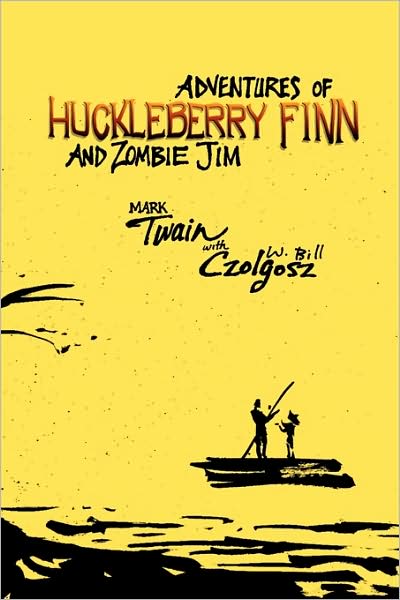
At The Mark Twain House & Museum, we assumed that it was only going to be a matter of time before Mark Twain’s works were going to be similarly splattered with zombie action. Our patience was rewarded with three traumatic tales that use Twain’s iconic Tom Sawyer and Huckleberry Finn. First out of the grave was W. Bill Czolgosz’s Adventures of Huckleberry Finn & Zombie Jim: Mark Twain’s Classic with Crazy Zombie Goodness (a limited release in 2009 via Coscom Entertainment, Huck Finn & Zombie Jim will be published nationally by Simon & Schuster in February 2010). In Czolgosz’s twisted tale, a mutant strain of

tuberculosis has swept the South, causing the recently deceased to bebagged to avoid the spread of contagion. If the dead reanimate and are docile, they are used as slaves for the good of society. If they are vicious, they are dispatched. When Pap Finn, the worst of these “baggers” reanimates, Huck sets out for freedom with his friend Bagger Jim.


In August 2010 via Tor Publishing, Don Borchert decided to exhume The Adventures of Tom Sawyer by adding “…and the Undead.” Using the skeleton of Twain’s tale of boyhood adventure, Aunt Polly not only tries to keep Tom on the straight and narrow, she must also protect him from the marauding “Zum” that have shambled out of the grave. Instead of painting Aunt Polly’s fence, Tom must trick his friends into sharpening the fence posts that will gore any zombies that attempt to ransack his home. Of course, Tom’s nemesis, a mutant Injun Joe, provides hair-raising and vomit-inducing action that propels the story forward. Much of Borchert’s book utilizes Twain’s original text and piles on the marauding corpses.


IDW Publishing decided to take a different tack in attacking the classics. In their new omnibus Classics Mutilated, they have unleashed genre writers on classic characters and freshly inter them in new stories. Thus, Huck, Tom and Jim have an all-new adventure in the H.P. Lovecraft/Song of the South send-up Dread Island, written by prolific horror and crime novelist Joe R. Lansdale. Lansdale is the “Champion Mojo Storyteller” behind The Hap Collins and Leonard Pine Mysteries, Bubba Ho-Tep and the Jonah Hex graphic novels. In Dread Island, the novella that serves as the centerpiece of Classics Mutilated, Twain’s iconic characters set off for a mysterious island in the Mississippi that is home to Uncle Remus’s friends Brer Rabbit, Brer Fox, among others.


On Saturday, October 30th at 4 p.m., The Mark Twain Museum Center will host Mark Twain & The Army of Darkness, a conversation between Borchert, Lansdale and Czolgosz (appearing via Skype from his home in Saskatchewan) about what it took to give Twain’s classics a macabre makeover. The conversation will be moderated by Sam Hatch from WWUH’s Culture Dogs and will include a sneak preview of scenes from the film-in-progress Ninja Zombies, currently being shot in Connecticut. Borchert and Lansdale will be signing their books immediately following the lecture. Admission is $5 and free for museum members. Interested attendees (live or dead) can avoid a grave mistake by calling (860) 280-3130 to reserve their plot. There will be a Steampunk Tea Party before the lecture at 2 p.m. Admission to the tea is $10.


So what would Twain think of this literary massacre? Evidence suggests that he would have been all for assaulting Austen’s work. In a letter to William Dean Howells, Twain writes, “It seems a great pity that they let her die a natural death.” Writing to Rev. Joseph Twichell, he states, “Everytime I read Pride and Prejudice, I want to dig her up and beat her over the skull with her own shin-bone.” Twain himself speaks from beyond the grave with the 2010 release of his sprawling autobiography which roams the Earth after being buried for 100 years. As for Twain’s other novels being mutilated, one has to wonder if we can look forward to The Prince and The Putrid, A Connecticut Yankee in King Arthur’s Crypt and Good’ndead Wilson.


- Jacques Lamarre, Director of Communications

Thursday, October 14, 2010

All of us contain Music & Truth

This Saturday, The Mark Twain House will collaborate with many of our neighbors to present an evening of Music and Truth related to our favorite author, Mark Twain. "Music and Truth: A Tribute to Twain" will be held at Immanuel Congregational Church across the street from The Mark Twain House on Farmington Avenue. The following remarks will be the opening to the event.

When Mark Twain was living in Vienna in 1898, he heard an impressive piano recital by Stefan Czapka, a fellow student of his daughter Clara. Afterward, he autographed a photo for Czapka, and inscribed above it: “All of us contain Music & Truth, but most of us can't get it out.”

Tonight a number of talented and lively musicians, actors and readers will get the truth out, with a vengeance. Acclaimed pianist Paul Bisaccia, Hartford Children’s Theatre, the professional choral ensemble Voce, and The Mark Twain House & Museum are all contributing to celebrate the music Samuel Clemens both loved and loathed, along with readings from his beloved works. Highlights will include selections from the musical The Apple Tree (based on Twain’s “The Diaries of Adam & Eve”), spirituals and popular tunes from the Victorian Era, a world premiere of a piano piece by Hartford composer (and Twain contemporary) Dudley Buck, a little sampling of Richard Wagner, a composer who failed to measure up to Twain’s standards (Twain said in A Tramp Abroad that “Some of Wagner’s operas bang on for six whole hours on a stretch!”).

It’s deeply appropriate that this concert is being held at Immanuel Congregational Church, which is instutionally descended from the Rev. Horace Bushnell’s church – Bushnell the rebel theologian and park-builder, who in old age used to drive his carriage at high speed down Farmington Avenue, kicking up the dust in front of Sam Clemens’ house. Clemens knew and admired Bushnell, and used the reverend’s famous book on child-rearing to help raise his three high-maintenance daughters.

According to tradition, when Immanuel was built across the street from his Hartford house one year after that Vienna piano recital, Sam Clemens, back in town on a visit, dubbed it “the Church of the Holy Oil Cloth.” The unusual green-and-cream patterns on its façade reminded him of the standard colors and patterns of oil cloth, the material used on kitchen floors before linoleum was invented.

The Mark Twain House & Museum is proud to participate in this major event in the Woodland Concert series, paying tribute to Twain on the Centennial of his death – and the 175th anniversary of his birth. As neighbors of the church, we have been happy to partner with it in this effort as we have partnered with many other community groups – continuing our role as an important site in Hartford, the place that Mark Twain called chief among all the cities he had seen.

- Julia Pistell & Steve Courtney

“Music & Truth: A Tribute to Twain” is sponsored by Reid and Riege, P.C., The Edward C. and Ann T. Roberts Foundation, Hartford Dental Group and St. Francis Hospital and Medical Center, the Greater Hartford Arts Council, the J. Walton Bissell Foundation, Inc., and Barbara David.. The event is one in the museum’s continuing series of Mark Twain 2010 Centennial Celebration events . The Hartford Financial Group, Inc., is the Mark Twain House & Museum’s Centennial Sponsor.

Wednesday, September 29, 2010

Banned Book Week

A post by our fantastic new curatorial assistant, Mallory Howard.

In honor of banned book week, I thought it would be interesting to take a look at Mark Twain’s infamously banned novel, Adventures of Huckleberry Finn. In the late 1800’s Adventures of Huckleberry Finn was originally banned because Huck Finn was a “bad boy” who had no morals and bad manners. Mothers certainly didn’t want this example to be set for their children and therefore did not allow the book to be read. It also came under fire for its language, but not the language that we find offensive today. In Concord, MA part of the reason it was banned was because Huck said, “sweat” instead of “perspire.” In more recent years Huck Finn has been banned due to its use of the “n-word,” which shows up consistently throughout the novel. This coarse language is deemed by some to be extremely offensive and results in some schools refusing to teach it or carry it in their libraries. Those who defend the novel argue that too often the language is taken out of context and should not be viewed with 21st century eyes, doing so can indeed cause conflict. However, when studied from a 19th century context, the book coincides exactly with how most people spoke, felt, and thought.

Another criticism of the novel, which has helped in the argument of the books banishment, is the portrayal of Jim, the African-American slave who travels with Huck down the great Mississippi river. Some are upset that Twain depicted Jim as an “unintelligent, jolly, black man,” who seems unable to accomplish much of anything. This is a common misconception people have about the character of Jim. In chapter nine of the book, Jim and Huck encounter a sunken boat with a dead body inside. When Jim takes a closer look he realizes it is Huck’s abusive, alcoholic father, Pap Finn. Pap is the reason Huck is determined to run away in the first place and Jim quickly realizes if he relays this information to him, he is a goner. He needs Huck as protection, to shield him from the possibility of being hunted down and dragged back to slavery. Jim is concerned with self preservation and proves to be quite intelligent in making sure that he is successful is attaining his goal to leave the South and the enslavement that goes with it.

Craig Hotchkiss, the Program Manager for the Mark Twain House & Museum states that by banning books like Huck Finn, “We are diminishing the power that literature is supposed to have. Great literature it supposed to be disturbing and uncomfortable.” We at the Mark Twain House are dedicated to educating others about the importance of reading books like Adventures of Huckleberry Finn. Despite our best efforts to correctly teach the book and broaden the understanding of the novel and its important messages, it is still banned in schools and libraries across the United States. No restraints should be placed upon books, for they represent the freedom of speech and expression that we have fought so hard for and continue to fight for. Protest the injustice of book banning by exercising your freedom to read what you want to! I encourage all of you to pick up Adventures of Huckleberry Finn or any other banned book, and read it!

- Mallory Howard


Thursday, September 23, 2010

Weddings and dinners and all sorts of things!

The Mark Twain House & Museum is thrilled to announce that we are re-invigorating our facilities rentals. That's a really boring way to say that you can now rent spaces in our museum for delightful and intellectual events in your life, such as a company conference, screening your movie in our theater, or in the case of a lovely Hartford couple-- get married on the ombra!


Aren't they great?

To learn more about facilities rentals please visit our website.

- The Mark Twain House & Museum

Wednesday, September 8, 2010

"The Gilded Age" Onstage

In advance of Ellen Faith Brodie and David Pellegrini of Eastern Connecticut State University's September 16th reading of a new stage adaptation of “The Gilded Age,” Mark Twain House & Museum’s Director of Communications Jacques Lamarre explores the novel’s previous journeys to the stage. The reading will be performed by students from Eastern CT State University's Performing Arts Department Theatre Program


Mark Twain is most famous for his novels, short stories, and his observant and incisive non-fiction. He is also well known as an orator who circled the globe entertaining audiences with his quick witticisms. His stage performances, although portraying no one other than himself, were a master class in comic timing and displayed his consummate grasp of how to hold a crowd rapt. Despite his indubitable way with words and his undeniable stage presence, one area of accomplishment eluded him that seemed to be well within his reach -- to be a truly successful dramatist.


During Twain’s lifetime, he was an avid theatre-goer. According to Shelley Fisher Fishkin, “young Sam Clemens was exposed to mock Shakespearean orations and swordfights, minstrel shows, and amateur theatricals. When he left home at age seventeen, he attended his first professional theatre in New York, Philadelphia, St. Louis and Keokuk, Iowa.” (“Mark Twain and the Theatre,” Afterword, Is He Dead?, p. 147) He spent time writing theatre criticism during his tenure as a journalist for the Virginia City, Nevada Territorial Enterprise and he championed the cause of the acting profession when he became a founding member of the still-extant Players Club in New York. As much as he loved attending and debating the merits of plays, he saw huge money-making potential in the theatre.


The only play Twain wrote that was a success during his lifetime* had an odd beginning, much like the novel that serves as its basis. Twain’s first novel, a collaborative effort with his Hartford neighbor Charles Dudley Warner, was born as a result of dinner table conversation. After eviscerating novels that they found lacking, their wives challenged them to write one that was better. The two men took up the challenge and the resulting novel The Gilded Age – A Tale of Today was published in 1873 and became an immediate success. R. Kent Rasmussen sums up the book as “a sprawling epic with multiple story lines and dozens of characters…a melodramatic saga of a Midwestern family nearly destroyed by its faith in illusory wealth and a fierce satire of post-Civil War America. The novel skewers government and politicians, big business and America’s obsession with getting rich.” (Rasmussen, Mark Twain A-Z, p. 167) Aside from a title that has since become associated with the gilt-edged era of excess that it satirizes, The Gilded Age may be best remembered for the character of Colonel Sellers, a comic schemer who always sees fortune in speculation shouting, “There’s millions in it!”


Undoubtedly, Twain and others saw millions in Colonel Sellers coming to life onstage. In 1873, Twain and Warner filed for copyright protection for “The Gilded Age: A Drama” and approached playwright Dion Boucicault to adapt the work for the stage. After Boucicault insisted on a three-way split of the profits, the idea was shelved. According to Jerry Thomason and Tom Quirk, Twain may have attempted his own adaptation of the novel in February 1874, an effort that was ultimately discarded. (Introduction, Colonel Sellers: A Drama in Five Acts, The Missouri Review, p. 111) In April 1874, Twain and Warner discovered that, despite their copyright, a stage version of The Gilded Age dramatized by G.B. Densmore had been launched in San Francisco and became an immediate hit with comic actor John T. Raymond playing Colonel Sellers.


Twain smelled money and quickly entailed the San Francisco production and purchased the Densmore script for $400 ($200 for the script with an additional $200 promised if Twain’s adaptation became a success). Twain set up an agreement with Warner that each author of the novel owned the rights to the characters they had individually created without royalty due to the other. Successfully quarantining any financial obligation to Warner, Twain set about adapting, augmenting and embellishing the Densmore script (while, apparently, pinching some of Warner’s material despite their agreement). The resulting stage play was subsequently entitled Colonel Sellers and written with actor John Raymond in mind.


Colonel Sellers made its debut at the Park Theatre in New York on September 16, 1874. The play was an immediate success with audiences. Critical opinion appears to be sharply divided. “James T. Fields found it ‘simply delicious’; President Grant went backstage to compliment Raymond; and the Atlantic, as well as several daily papers, was full of praise.” (Justin Kaplan, Mr. Clemens and Mark Twain, p. 180). Other reviews were not as kind: “George Odell’s Annals of the New York Stage dubbed Colonel Sellers ‘a wretched thing,’ while the New York Tribune called it ‘excessively thin in texture.’” (Fishkin, Afterword to Is He Dead? p. 149) Twain himself acknowledges the piece’s shortcomings in a letter to William Dean Howells, “It is simply a setting for the one character, Col. Sellers, and as a play I guess it will not bear a critical assault in force.” Regardless of the critical reaction, the play must have exceeded Twain’s expectations – it toured consistently for 12 years and brought him royalties in excess of $100,000 during its time on the road. “The daily reports of the profits arrived in Hartford around dinnertime, and Howells recalled that Clemens would spring to his feet, fling his napkin on his chair, and in ‘wild triumph’ read aloud the ‘gay figures.’” (Kaplan, Mr. Clemens and Mark Twain, p. 180)


Sadly, the success of Colonel Sellers was not a harbinger of future success on the boards for Twain. His next effort Ah Sin, a collaboration with Bret Harte, was by all accounts a disaster and closed after one week. Attempting to return to the Colonel Sellers well, he wrote a sequel with William Dean Howells for John Raymond to perform entitled Colonel Sellers as a Scientist. Raymond, whose relationship with Twain had begun to sour, demurred at the opportunity to revisit the character in an inferior vehicle. Twain went on to eviscerate Raymond in Mark Twain’s Own Autobiography, stating, “The real Colonel Sellers was never on the stage. Only half of him was there. Raymond could not play the other half of him; it was above his level. That half was made up qualities of which Raymond was wholly destitute. For Raymond was not a manly man, he was not an honorable man or an honest one, he was empty and selfish and vulgar and ignorant and silly, and there was a vacancy in him where his heart should have been.” (Mark Twain’s Own Autobiography, p. 9) This disparaging assessment is pure Twain, but shocking when measured alongside the extraordinary debt Twain owed Raymond; thanks to the actor, Twain made more money each year that Colonel Sellers toured than he realized from his books. During his lifetime, it was one of his greatest financial successes.


In 1986, Hartford’s relationship with The Gilded Age was reignited when Hartford Stage engaged playwright Constance Congdon to adapt the tale under the direction of Mark Lamos. In 2010, Eastern Connecticut State University professors Ellen Faith Brodie and David Pellegrini have created their own stage adaptation of the novel, once again bringing Colonel Sellers to dramatic (and comic) life. Finding the book’s original subtitle “A Tale of Today” to still be apropos, Brodie and Pellegrini’s version dials down the melodrama and pushes Twain and Warner’s themes of political gain and financial greed to the fore. The Mark Twain House & Museum will present the first public reading of their script at a free program on Thursday, September 16th at 7 p.m. in the Museum Center auditorium. The Brodie/Pellegrini version will then be fully staged by the ECSU Performing Arts Department Theatre Program November 9th through 14th, 2010 at the Harry Hope Theatre on the University’s campus. Undoubtedly, Twain would be thrilled to find that Colonel Sellers is still bringing in the crowds.


*Twain’s recently-exhumed 1898 play Is He Dead? is generally conceded to be his best work for the stage and enjoyed modest success on Broadway during the 2007-2008 season and subsequently on regional stages.

Tuesday, August 31, 2010

Mark Twain’s Connecticut

The Mark Twain House & Museum is very pleased to be collaborating with the folks at the Wilton Historical Society (Wilton, CT) and the Mark Twain Library (Redding, CT) on the exhibition, Wilton’s Friend: Mark Twain, which opens on September 1st at the Wilton Historical Society.

Over the course of his seventy-four years, Samuel Clemens (Mark Twain) traveled to over thirty states, and crisscrossed the globe, visiting five continents, crossing the Atlantic twenty-nine times, and crossing the Pacific and Indian oceans as part of his round-the-world lecture circuit. He wrote to his mother, “All I do know or feel, is, that I am wild with impatience to move—move—Move!”

When the time came for him to settle down, Clemens chose Connecticut. In fact, the only two homes that he ever constructed for himself were both in the state. In 1874, as his career was exploding, Clemens built a large mansion in the Nook Farm neighborhood of Hartford for his growing family. In 1908, toward the end of his career, he built an Italianate-style villa, which he named “Stormfield,” in Redding.

Both of these homes represented a sense of stability and permanence to Clemens, and they were equally special to him. Wilton’s Neighbor, Mark Twain, brings together artifacts belonging to The Mark Twain House, Mark Twain Library, and the Wilton Historical Society to give an intimate look at Twain’s life in both Hartford and Redding.

Visitors to the exhibit will get a chance to see some special items from our collection that you don’t normally see when you visit Hartford. Items such as Twain’s billiard cue and humidor, his patented inventions of the “Mark Twain’s Memory Builder” and Self-Pasting Scrapbook, and his family’s picnic basket (which includes some silverware items lifted from Long’s Hotel in London) all give insight into the lives that our beloved author and his family led while living in Connecticut.

We hope you’ll get a chance to visit Wilton’s Neighbor: Mark Twain before it closes on October 31st.

~ Patti Phillipon, Chief Curator of The Mark Twain House & Museum

Thursday, August 12, 2010

Double Blog

The Mark Twain House & Museum is constantly working on several projects at once-- you may have noticed our advertising for our Ghost Tours, foodie events, educational programs, and more-- but we're also building up momentum on a project that isn't quite as fancy but vitally important to the author's legacy.

Last Spring we launched a brand-new program that has long been a dream of the staff here: Writing at The Mark Twain House. Our flagship course was taught by Lary Bloom and Suzanne Levine and focused on Memoir. Our students spent eight weeks writing and critiquing their work. Due to their successes, we're delighted to announce that we will continue to offer Writing Workshops at the Mark Twain Museum Center for as long as aspiring and established writers keep on coming back to take them.

We also are committed to displaying our writers' voices, and so we have started a second blog entirely devoted to the product of these workshops: Writing at The Mark Twain House. That blog will display the writing of our students as well as announce upcoming courses and report on the progress we're making in the program. Please follow it!

As if that weren't exciting enough, we're also thrilled to announce that the next round of Nonfiction writing workshops will be taught by the illustrious Susan Campbell, author of Dating Jesus and columnist for the Hartford Courant. Classes will treat all manner of non-fiction work, from opinion writing to autobiography to essay writing to general truth-telling, guided by the spirits of E. B. White, Jessica Mitford, Tracy Kidder and Joan Didion, among others. The six sessions run from 5:30 to 7:30 p.m. on Wednesday evenings, beginning Nov. 10 and running to Dec. 22 (no class Nov. 24). There is a fee of $500. Call Steve Courtney at 860-247-0998, Ext. 243, steve.courtney@marktwainhouse.org.

We hope that you are as excited about this set of programs as we are! Let us know in the comments what you think, what kind of writing workshop you'd take, and which writers you'd love to see here at the Twain House.

-- Julia

Friday, July 30, 2010

Scholarly Pursuits

At Boston University on August 20-22, three staff members of The Mark Twain House & Museum will be giving lectures at the Twain/Tolstoy Symposium. Mallory Howard will speak on Twain's marginalia, Julia Pistell will give a lecture on wit in Twain's nonfiction, and our Chief Curator Patti Phillipon will deliver the keynote address. We're all very excited and a bit nervous to collaborate with so many fantastic scholars.

This is Julia writing today's blog post, and I have been working on my lecture every day for the last week or so. I'm fairly new to the Twain House, and much of my time is spent doing things like researching famous moustaches and organizing the logistics of writing workshops, so I'm trying to catch up on my scholarly work. I'm currently reading the Justin Kaplan biography Mr. Clemens and Mark Twain, and I've already written about several other Twain biographies is a previous post. I've worked for the Twain House for a year now, and have picked up what feels like a lot of information about Sam's legacy and work. Yet, I can't help but feel that I will never be a real Twain scholar. There's just so much to know.

It's also a horse of a different color to become a Twain expert as opposed to, say, a J.D. Salinger expert. Twain wrote so much, and an absolutely insane amount of letters, and has captivated the American imagination for about 140 years. There are so many experts that have come before us, what does it take to throw a hat in the ring?

My favorite line in the Kaplan biography is the following: "Recognizing that Orion was bound by the laws of his nature to a lifetime fickleness of purpose and a butterfly vagrancy, Sam once meant to reassure him that there was no reason why a kaleidoscope should not have as good a time as a telescope." I've decided that my current kaleidoscopic view of Twain is lovely in its own way, and an excellent jumping-off point for becoming more telescopic.

So what do you think, loyal readers? At what point does someone become an expert? A scholar? An aficionado? A Twainiac? I'm going to keep thinking about it, but I'd love to hear your thoughts, too.

-- Julia

Tuesday, July 20, 2010

Letter from a Fan

We asked one of our most frequent Mark Twain House facebook commenters about her enthusiasm for Twain. She wrote us this lovely letter. Thanks, Marie!

Good afternoon!

Well, I was asked why I am so fascinated by the Mark Twain House, and all it entails. Let me share some of my thoughts on this.

First, it is exciting to know that the Mark Twain house, and museum, is only about 30 minutes from me, here in Ct. It makes me proud, as well, because he gave the world so much.

Next, I am a writer, and when I step into the M.T. house, I step into his world, and relate to many things: he was a deep thinker, and writes of his beliefs, interests, and things he wanted to share so much. He learned to take care of himself growing up, as I did, and he grew up by the river--I grew up by the Atlantic Ocean.

During his time, there were slaves, and although we no longer have slaves, I am a slave to my writing, many times kept captive, because there is so much I would like to share with the world, but held back.

For me, I absolutely love anything from the 1800s: antiques, the styles, the way they lived, the decor, the beauty of the homes, and all. To step into Samuel Clemen's home, and visualize him and his family living there, or the family sitting at the table for meals, or know he reclined in that house creating stories and more, profoundly warms my heart.

It all may sound corny to you, but he was an every day person who achieved a goal in life--writing and sharing his innermost thoughts, and I am the same, just not a well-known.

Honestly, I only know of what I relate to in what I have mentioned. When I worked in a middle school, and we talked about Samuel Clemens, I learned quite a bit, and the wheels started turning in my head because I related to many things about him.

When I realized the Mark Twain House was not that far, I couldn't wait to get there, and to actually step foot into the past. I have visited a few times, and each time I am almost speechless to know that I walked the same stairs he and the family did, be in the rooms that he actually was in, and more.

How I would love to sit down with him today and experience how he thinks, and maybe, realize that we are both alike as writers; the good days, the bad days, the writer's block, how he got his ideas--I bet I have been through the same things he has.

To think that his beautiful house only cost about $40,000 back then. Could you imagine what it would be worth today, with all those rooms and all the land, as well as the servants house (?) etc.

I am a deep thinker, but down to earth. I think Samuel Clemens was a little bit eccentric. However, in my closing thoughts, I want to say that I feel one in the same with someone whom I have never met, but have the chance to visit the Mark Twain House whenever I want, and be "wow'd" because maybe one day someone will be feeling the same about me. I am not sure he wrote poetry, but most of my work is poetry--a therapy for me; I have been writing since I was 8 years old. I am only now working on children's stories, a memoir, other books, and worked for newspapers, writing feature stories--I believe Samuel Clemens also worked for newspaper outfits.

When I visit, I take pictures of as many things as I am allowed at the Mark Twain House, and use my photos as postcards ( as well as hundreds of other "kodak moments"), and love to send them to children I know, elderly, the lonely, the sick, shut-in's, etc. and share with them something special, teaching them, and giving them something special to experience. Most of them will never get there, so I am very lucky that I can!

If anyone is interested receiving, or know of someone who would like to receive my "Mark Twain" postcards, or other postcards because they are shut-in's or lonely, etc, please let me know. I do a postcard/card/letter ministry at no charge--it is my hobby.

Know that the Mark Twain House is getting some free publicity! It makes me happy to do this--if Samuel Clemens only knew!

Thank you for your time.

Marie Serio DellaValle

Tuesday, July 13, 2010

10 Moustaches We Love

Tomorrow's Summer Social and Moustache Party will be just that-- a party. Amongst all of these lectures, musical tributes, family events, writing workshops, and sold-out tours, we wanted to give a nod to Sam's love of a nice evening socializing.

There are so many fantastic elements to this event I can't even bring myself to put them into full sentences:

- Only $10 and $5 for members!
- Ice Cream from the UConn Dairy Bar included in admission (locally made!)
- One Huckleberry Vodka Lemonade ALSO included in admission (courtesy of 44 North!)
- Puppeteer Anne Cubberly will be on hand to help you make your own felt moustache
- Catie Talarski of WNPR will be on hand to judge best Moustaches (real and fake)
- Locally renowned band String Theorie will play on the porch of the house
- Bocce, badminton, Twister, horseshoes and more to play on the Harriet Beecher Stowe Center lawn
- Scrabble, Balderdash, chess, and more to play indoors if it rains!
- A cash bar no matter what! The happiest happy hour of all!
- 5-8 PM on a Wednesday-- I'd call this the best happy hour ever.

But without further ado, I present to you ten moustaches we love.

1. Salvador Dali. If you're going to wear a moustache, might as well accessorize with an ocelot.


2. Charlie Chaplin. Just classic.

http://www.youtube.com/watch?v=xoKbDNY0Zwg

3. This guy! Keep watching for the 'stache.

http://vimeo.com/7877526

4. The fine folks at Movember. This is actually a LOT of moustaches, but the cause is awesome and you can participate all over the world.

http://us.movember.com/

5. My friend Rachel's dog's moustache.


6. Sexy fish moustaches.

7. Fun uncles of the world. I have a fun uncle with a moustache, do you?

8. Wow!


9. This person is serious about his efforts.


10. Of course...


See you tomorrow evening, rain or shine!

- The Mark Twain House & Museum

Tuesday, June 29, 2010

The Greatest Person from Back Then Ever

One of our current exhibitions in our Museum Center is Legacy: an examination of how Mark Twain’s presence still lives with us today. After reading what authors and public figures (including Tom Wolfe, David Baldacci and Roy Blount Jr.) have to say about Twain’s relevance, many of our guests write their thoughts on Sam and his legacy in one of our guest books. Today we thought we’d pull out a few of our favorite comments.

Without further ado, here are my top ten favorite Legacy comments and the reasons why I love them:

1. “How to describe Mark Twain’s Legacy? America is his legacy. Some people know more about him than they know about US Presidents. More people know his stories than probably any other author.” -- Jon

The Mark Twain House & Museum draws visitors from all over the world for just this reason. Sometimes it seems like everyone can tell a Sam story, or feels that they personally know Tom and Huck. Fiction is powerful.

2. “Mark on Sam: You were so ahead of your time in the sympathetic portrayal of Jim.”

Adventures of Huckleberry Finn is one of the major reasons that we still study Sam in school, and Jim is one of the major reasons the novel is so fantastic. Thanks for reminding us, Anonymous!

3. “Mark Twain would have an ipad and an appearance on ‘Oprah.’ ”

Yes! Always the celebrity, and always curious about new technology.

4. “Becky Thatcher is the coolest character EVER created.”

I tend to agree. Becky is such a smart, hilarious, brave little girl. It’s no wonder Tom fell so hard for her.

5. “Dear Mark Twain you are an asome writer to me you’re a good ilistrater” – Frome your Best Brother: Edwin

Based on this commenter’s handwriting, I think he’s just learning to read and write. We’re pretty excited that Twain’s stories are compelling to even the newest of literary minds.

6. “You helped me enjoy my childhood in a little town in Iran.” -- Faridet, age 60

Tom Sawyer isn’t just a boy from the Mississippi River: he’s every kid, as we’ve learned over and over from our visitors.

7. “I heart Samuel Clemens. P.S. Sorry about your kids.” – Katelyn

I know, Katelyn. I know. For those of you who don’t feel the pain, watch Ken Burns’ documentary and cry along with Katelyn and me.

8. “I think it’s cool that he has a lot of humor.” - Kevin

Well hey, so do I! That’s one of the reasons I love working for this place!

9. “I think Mark Twain did a good job with his life. He has a great wife, kids, personality. So Mark Twain is actually a good man. He also traveled halfway around the world. Good job Mark Twain.” – Shella

Not all writers were as successful as Sam at nearly every single facet of life. Even though he suffered trials and tribulations throughout his life, Shella is right: good job, Mark.

10. “You are the greatest person from Back Then ever.”

Heck yes!


Honorable mention: “Alex Trebek is the Best!”

For $1000: What is Julia's favorite comment in the comment book?

Wednesday, June 16, 2010

A Quagmire of Quotations

Mark Twain is justly known for his many quips, witticisms and pithy observations. Across his novels, short stories, letters, speeches, plays and newspaper stories, he left a vast amount of quotable statements on everything from “Abstinence” to “Zug.” Seemingly he had an opinion on everything – human nature, animals, war, religion, politics, literature, love, family, money, history, friends and enemies. There are volumes dedicated to his succinct and often humorous assessments on a plethora of subjects.


One challenge with Twain quotations is the frequent misstatement of what he said. An example is the infamous “Reports of my death have been greatly exaggerated!” quote. We have used this quote in print ads and on a t-shirt in our store. It is, in fact, not what he said – or at least not how he said it in the following note written in May 1897:

“James Ross Clemens, a cousin of mine was seriously ill two or three weeks ago in London, but is well now. The report of my illness grew out of his illness, this report of my death was an exaggeration.”


Shame on us for perpetuating this mistake!


The famous quote attributed to Twain “I am not an American. I am the American.” makes for great copy. Unfortunately, Twain himself (American or not) did not say this about himself – he was repeating a quote from his friend Frank Fuller. Similarly, the much-repeated “There are three kinds of lies: lies, damn lies and statistics” is attributed to Twain who was, in fact, quoting Benjamin Disraeli. The very funny “Wagner’s music is better than it sounds” was actually said by the very funny Edgar Wilson Nye.


Recently I was asked by two visitors to our website to confirm the provenance of two quotes commonly attributed to Twain:


“Golf is a good walk spoiled.”

“Twenty years from now you will be more disappointed by the things that you didn’t do than by the ones you did do. So throw off the bowlines. Sail away from the safe harbor. Catch the trade winds in your sails. Explore. Dream. Discover.”

After doing some research and asking around, these two popular quotes that are routinely attributed to Twain could not be definitively confirmed as his words. I reached out to Barbara Schmidt, the webmaster and creator of the superlative www.twainquotes.com and asked her to share some of the most commonly repeated apocryphal Twain quotes. In her words (and, yes, I am attributing this quote with confidence): “Twain has been labeled a ‘quote magnet.’ Anything that sounds good is often misattributed to him.” The following is her list of some of the most frequently misattributed quotes.


"The coldest winter I ever saw was the summer I spent in San Francisco."


“Whiskey is for drinking; water is for fighting over.”


“When I was a boy of fourteen, my father was so ignorant I could hardly stand to have the old man around. But when I got to twenty-one, I was astonished at how much the old man had learned in seven years.”


“Be careful of reading medical magazines; you might die of a misprint.”


“Don't argue with people who buy ink by the barrel.”


“Denial is not just a river in Egypt.” (or “Denial ain’t a river in Egypt”)


Barbara is not saying that Twain didn’t say these things per se. On her website, some of these alleged quotes are followed by the statement, “This quote has been attributed to Mark Twain, but until the attribution can be verified, the quote should not be regarded as authentic.” When in doubt, Barbara recommends the following: “One of the best ways to research misattributed quotes is to use Google book and Google news archive searches for exact phrases. You will often find the first usage of such a phrase long after Clemens's death and not in any of his known works.” When we are in doubt, we generally turn to Barbara’s website or Caroline Thomas Harnsberger’s excellent Everybody’s Mark Twain and Mark Twain at Your Fingertips. Of course, our store has several terrific Twain books that are filled with correctly attributed quotes.


Much like the “Telephone Game,” these supposed Twain quotes may have been passed along, reported, re-reported, misstated, attributed and misattributed. In the end, many of them are simply very funny and therefore sound very Twain. He probably would be amused, but just like all of us, he probably would not be thrilled to have people put words in his mouth!


Jacques Lamarre

Director of Communications

Thursday, June 10, 2010

Is The Mark Twain House really haunted?


Shortly after I arrived at The Mark Twain House & Museum a year ago, I received an inquiry from the Smoking Gun Research Agency (SGRA), a CT-based paranormal group. Having received seven reports of suspected ghostly activity from visitors who had attended tours of the house, they were requesting the opportunity to conduct an investigation of the Clemens Family home.

Being new to the historic house museum business, I was not aware that these requests are a fairly common occurrence. I asked around if we previously had allowed paranormal investigations in the house. The answer was “no.” I then asked if the house was thought to be haunted. The answers ranged wildly. Some of the staff have reported no experiences whatsoever. Several employees do not believe in ghosts and think it is all bunk. Surprisingly, however, there were a substantial number of historic interpreters (a.k.a. tour guides) and security staff who had experienced the unexplained. Twain’s daughter Susy did die tragically in the house and many believe she never left. Some think the Clemens Family’s butler George Griffin is still looking after the home.

We agreed to allow SGRA into the house for a one-night investigation in August 2009. Although the house did not come alive that night with the full array of paranormal activity that people report experiencing – knocks, bangs, full-body apparitions, spectral voices, articles of clothing being tugged, cigar smells – SGRA did feel the house was “energetically active.” This Saturday, June 12th at 2 p.m., they will offer “Haunting Twain,” a free public presentation of their investigation at ParaCon 2010. Their program is open to the public and will occur at the Howard Johnson Conference Center in Milford, CT (visit http://www.sgra.org/paracon2010/ for details).

In September 2009, we welcomed SyFy’s hit television show Ghost Hunters for a much more comprehensive investigation of the house. They sent three teams into the house at different times. They were armed with infrared cameras, video and audio recording devices, EMF detectors, and more. Their episode aired in December and revealed knocks, bangs, EMF spikes and shadow movement that could not be easily explained.

In March 2010, we were visited by SyFy’s Ghost Hunters Academy for a follow-up investigation. They conducted a two-night investigation involving several teams of cadets all vying for one coveted spot as a member of TAPS (The Atlantic Paranormal Society). If you want to find out the results of their investigation, you will have to watch our episode, which airs Wednesday, June 16th at 9 p.m. The Twain Team will be gathering at Woody’s Fish Tank (915 Main Street in downtown Hartford) to see and hear the TAPS Team findings. Please join us that night starting at 7 p.m. for a fun event.

So, ultimately, is The Mark Twain House haunted? The skeptics are still skeptical. The believers are even more convinced that there is something floating around in the house. Me? I haven’t experienced anything, but I’m open to the possibility. We invite you to make up your own mind by taking our Graveyard Shift Ghost Tours which start up this summer on Friday, June 25th. These hour-long nighttime guided tours of the dimly lit Picturesque Gothic mansion are by reservation only, so call (860) 280-3130 to reserve your spot. You can review the evidence, hear spooky episodes from the Clemens Family history, discover Victorian traditions surrounding séances and death, and maybe, just maybe, you might hear something that goes bump in the night or see something that will make your hair stand on end.

- Jacques Lamarre, Director of Communications